
“Armbands and Shadows“ is a coming-of-age story soaked in sweat, sarcasm, and the long shadows of history.
Dan Connolly, a quiet lad from a faded Lancashire mill town, crosses the Irish Sea in 1981 to work with cousins he’s never met, in a country he’s only known through rebel songs and warnings whispered at family tables. He arrives with a kit bag, stories of men he never knew, and the vague hope of belonging somewhere — anywhere.
Thrown into the chaotic charm of Drogheda, Dan finds unlikely kinship in Seamus — a red-headed, fast-talking survivor of the care system with a battered van, a collection of Wolfe Tones tapes, and a talent for hiding pain behind punchlines. Together, they drift through building sites, boxing gyms, late-night dancehalls and quiet graveyards, tripping over the ghosts of their grandfathers while trying to outrun the weight of their own pasts.
Set against the backdrop of a divided Ireland, Armband and Shadow is equal parts bruising and tender — a novel laced with dark Irish humour, broken fences, and the quiet courage it takes to choose who you want to be when no one’s watching.
Because sometimes the fight isn’t to win — it’s just to stay standing.
“Not all fighters wear gloves — and not all wars make the history books.”
— a novel of bruised knuckles, buried pasts, and quiet rebellion.
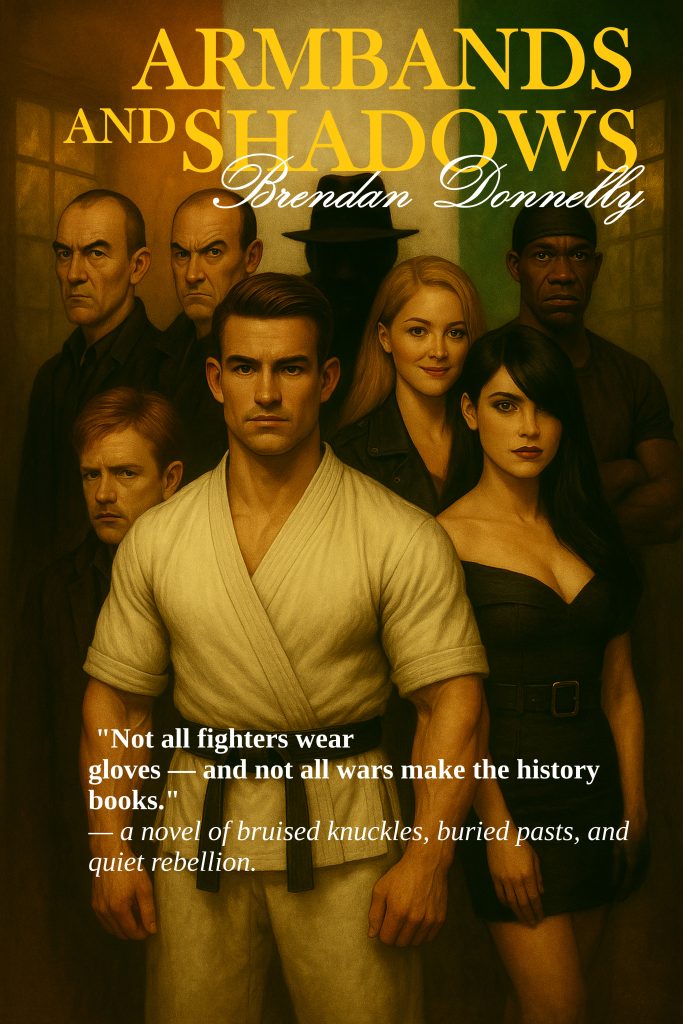
Sample
Prologue: World Cup 90
1990 was a warm, golden summer day in Ireland, the kind that seemed to hold its breath in anticipation. Outside the quiet bedroom window, the streets were still—silent and waiting—until suddenly, the roar exploded. From every corner of the country, people poured into the streets, waving tricolours, shouting, cheering. The streets transformed into rivers of green, white, and orange, alive with joy and disbelief. Ireland had just won the penalty shootout. The whole nation held its breath through each tense kick, and now the impossible had happened.
Inside, the man sat alone at his desk. Twenty-seven years old, and not much of a football fan—not really—but even he couldn’t escape the tidal wave of pride sweeping across the island. The noise was muffled through the glass, a distant thunder rolling beneath the walls.
He picked up a pen and stared at the passport application form before him. First international trip, he thought, the very idea still strange and new. His eyes lingered on the nationality box.
He poured a small glass of whiskey, raised it in a quiet toast to Ireland’s victory, then set the glass down. The passport form lay before him, the nationality box waiting. Outside, the streets roared with celebration — flags waving, voices rising in triumph.
But inside, a quiet stillness settled over him, memories stirred by the sharp scent of whiskey and the weight of that simple, empty box.
In the midst of the noise, his thoughts drifted far away — to a place where choices were never simple, and identity meant everything.
Excerpt. Chapter 17 :Dead On
The main bouncer, the big man in the suit, never lingered. He’d take one quiet pint at the bar, drink it slow, nod once, and disappear without a sound. He wasn’t there to socialise — just to watch, then leave. Still, people respected him. That kind of man didn’t need words.
But the owner, now he was a different story.
Paddy Coogan, from Tinahely in Wicklow, was in his early fifties — thick around the middle, cheeks red with permanent laughter lines, and a voice like he’d swallowed a hurley match and a trad session in the same gulp. He was an old show-band man in another life, still wore pointed boots and liked shirts with more collar than sense.
Tinahely, as he told anyone who’d listen, was “one church, one pub, two cows, and a hurley team with a grudge.” He’d left the hills behind years ago, but still swore nothing beat the pints at home. “Poured with patience,” he’d say. “Unlike the women.”